If you’ve spent more than a week in crypto trading chats, you’ve seen the same story on repeat: someone flexes a huge win “thanks to 25x,” and a few hours later posts their liquidation price like a memorial plaque.
Leverage in trading lets you control a much larger position with a smaller balance. Great when the market behaves. Brutal when it doesn’t. And most beginners jump into it without fully understanding the leverage trading meaning, relying on whatever settings they saw in a questionable Telegram screenshot.
This guide breaks down what is leverage trading crypto, how it actually works, how it can bury your trading account in hours, and provides a brief review of some popular margin trading crypto exchanges.
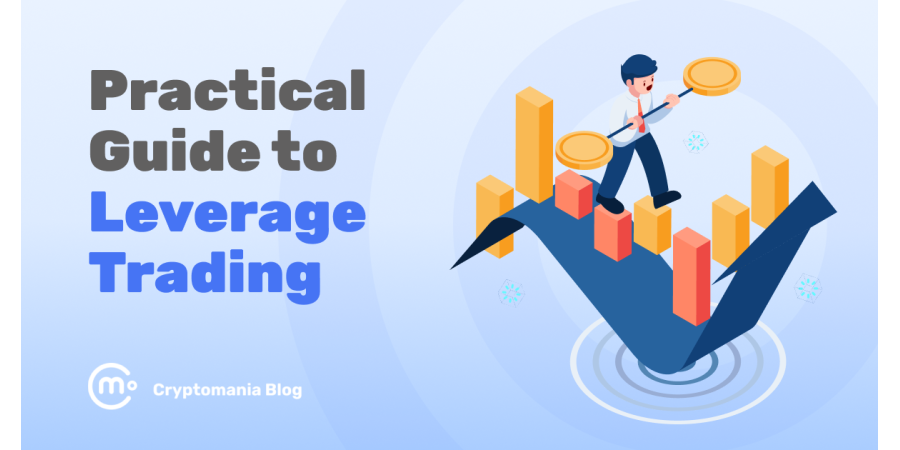
Leverage trading in crypto is exactly what it sounds like: you borrow extra capital from the exchange to open a larger position than your actual balance allows. Instead of trading with your own $100, you might trade with $500, $1,000, or even more, depending on the multiplier you choose.
This is the core leverage trading meaning: amplifying your exposure without increasing your upfront cost. That’s why it attracts so many traders who want “bigger profits” without waiting months for a slow spot chart to move.
It works through a simple setup.
You put down collateral (called margin), choose your multiplier, and the platform lends you the rest.
The result is a bigger position… and a much more sensitive one. When the market goes in your favor, you earn faster than on spot. When it goes against you, your losses stack up just as quickly and can trigger liquidation long before the chart looks “dangerous.”
Alright, we’ve already established that leverage trading is trading with borrowed funds. There are rules that you mustn’t break, otherwise, your account will be wiped out. That’s the mechanical side. The emotional side is realizing how fast numbers move when you multiply them.
That’s why tiny price changes suddenly feel catastrophic. A 1% drop on spot is boring. A 1% drop on 50x leverage? That’s liquidation speedrun territory.
So the full picture of how leverage trading works looks like this: you borrow capital, amplify your exposure, and accept that both profits and losses will move faster. A lot faster. And this brings us to…
While leverage trading might look exciting on paper, it comes with several risks that traders usually underestimate.
Here are the ones that matter most.
Liquidation risk
Your margin is the only buffer between you and a closed position. High leverage shrinks that buffer to almost nothing. Even a tiny price move against you can trigger liquidation long before the chart looks “dangerous.” It’s the fastest way to zero out an account.
Crypto volatility
Spot traders can survive a quick wick. Leveraged traders often can’t. Crypto’s normal price noise: random spikes, dips, and “liquidity hunts”, hits much harder when your position is multiplied both ways. What should be a small fluctuation can become a fatal swing.
Funding rates
If you keep a leveraged position open for a while, funding fees start eating into your margin. It’s not dramatic at first, but over hours or days it adds up, especially when your position is already under pressure.
Emotional pressure and overconfidence
One big win can make anyone feel invincible. That’s exactly when traders jump from 5x to 50x and start gambling instead of trading. Emotional trading is already risky; multiply it, and the outcome is usually predictable.
Platform liquidation curves & hidden variables
Every exchange calculates liquidation a little differently. Slippage, sudden volatility bursts, and thin liquidity can push your position closer to its limit than you expect.
Leverage doesn’t have to be the villain of your trading journey. The problem with multiplier is how people use it. If you treat leverage like a tool instead of a shortcut to instant gains, it becomes much easier to handle without blowing up your account.
1. Start with low leverage
Most traders jump straight to 20x or 50x because it “feels powerful.” In reality, anything above 5x already magnifies risk more than most beginners expect. Lower leverage gives you room to breathe, learn, and survive normal market noise.
2. Use clear entry and exit levels
Leverage multiplies every mistake. The more precise your plan is in terms of entry, stop-loss, and take-profit, the less likely you are to panic when the chart starts doing its usual nonsense. Don’t improvise in the middle of a candle.
3. Enter with small position sizes
Margin trading is a game of survival. Smaller positions reduce liquidation pressure and make it easier to hold a trade during volatility. Going “all in” with leverage is basically volunteering to get liquidated.
4. Respect the stop-loss
Some traders think stop-losses are optional. They sure aren’t. A hard stop keeps a bad trade from turning into a catastrophic one.
5. Avoid holding during high-volatility events
Moments like CPI prints, FOMC days, and big liquidation cascades create unpredictable whipsaws. If you insist on holding a leveraged position through them, you’re gambling.
6. Check funding and fees
Leverage increases your exposure, but it also increases the importance of costs. Funding rates and taker fees can quietly erode your margin if you hold positions too long or open them impulsively.
If you want to try leveraged trading, the platform you choose matters as much as the leverage level itself. Fees, liquidity, KYC rules, and security features directly affect your results as well as your stress levels. Below is a brief overview of the most popular margin trading crypto exchanges and some lesser-known alternatives.
The largest crypto exchange in the world, serving 270M+ users with spot, margin, futures, staking, and more.
Pros:
Cons:
Read more ➡️ Binance Exchange Review: A Beginner’s Guide to Crypto Made Simple
One of the biggest crypto exchanges globally, especially strong in derivatives and leveraged products.
Pros:
Cons:
Read more ➡️ Bybit Review 2025: Pros, Cons, Fees And Features
A major global exchange with strong liquidity and a full suite of margin, futures, and spot markets.
Pros:
Cons:
Read more ➡️ OKX Exchange Review 2025: Features, Fees & Security
A widely used exchange with millions of users and support for spot, margin/futures, and AI trading tools.
Pros:
Cons:
A popular platform focused on crypto leverage trading with low complexity. Often recommended for margin first-timers.
Pros:
Cons:
Read more ➡️ No KYC: Best Anonymous Crypto Exchanges 2025
A versatile platform with multi-asset support and leverage options. Not as huge as some competitors, but notable for its no-KYC tier up to certain limits.
Pros:
Cons:
Leverage trading exposes every weakness in your strategy a lot faster. When you use it with a plan, it can boost your returns and make your trading more efficient. When you treat it like a cheat code to skip the learning curve, it usually ends with a liquidation email and a quiet walk outside.
The key is simple: understand what you’re doing, manage your risk, and start small. Learn how margin, liquidation, and fees actually work before touching anything that looks like 50x.
And pick a platform that fits your experience level, or what’s even better, use paper trading as a training tool before using leverage with real money.
Read next: Spot, Leverage, and Futures Trading in Crypto: A Comprehensive Guide to Types, Benefits, and Risks